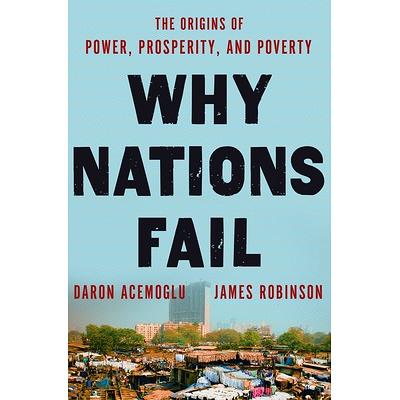
Why do some countries succeed while others stagnate? Why does prosperity flourish in one place, and poverty persist in another? In Why Nations Fail, Daron Acemoglu and James Robinson argue that the answer lies not in geography, culture, or even bad luck—but in institutions.
The book, first published in 2012, has become one of the most widely read explanations of economic development in recent years. Its central thesis is simple: inclusive political and economic institutions create the conditions for sustained growth, while extractive institutions ultimately undermine it.
Inclusive institutions, the authors explain, are those that allow broad participation, uphold the rule of law, protect property rights, and place checks on power. Extractive institutions, by contrast, concentrate authority and wealth in the hands of a few, often at the expense of innovation, accountability, and long-term investment.
It’s a persuasive argument, and one that resonates far beyond the case studies the book draws from—from England’s Glorious Revolution to South Africa’s apartheid state, from the collapse of the Mayan empire to modern-day North Korea. For readers in the Pacific, the relevance is hard to ignore.
Institutions in the Pacific: a mixed picture
Pacific economies have often been described as resource-rich but institutionally weak. Papua New Guinea, for instance, has vast mineral wealth but persistent service delivery failures. Solomon Islands has experienced repeated bouts of political instability. Vanuatu and Fiji have their own challenges around land governance, political turnover, and public sector performance.
What Why Nations Fail helps illuminate is that these challenges are not isolated or accidental—they are, in many cases, the predictable outcomes of institutions that limit inclusion and concentrate power.
Acemoglu and Robinson describe how extractive institutions can survive for decades, even centuries, because they serve the interests of those who hold political power. While these elites may adopt reforms or deliver basic services, they are unlikely to dismantle systems that benefit them. This helps explain why certain Pacific reforms—often struggle to take root.
Good policy, weak institutions
The book’s insights also speak to the frequent disjuncture between sound policy and weak implementation. In many parts of the Pacific, policies are well-intentioned and even well-designed—yet execution remains poor. Roads are built but not maintained. Education spending increases without improving outcomes. Revenue is collected, but budget allocations don’t translate into frontline service delivery.
In the framework Acemoglu and Robinson offer, this isn’t primarily a problem of capacity—it’s a problem of institutional incentives. If the institutions overseeing public finance, procurement, or accountability are extractive—even subtly—then we should not be surprised when resources leak or outcomes disappoint.
No quick fixes
What’s refreshing—and sobering—about Why Nations Fail is its rejection of quick fixes. The authors argue that deep institutional change is often slow and politically contested. There are no silver bullets. Foreign aid, technocratic reforms, and even democracy itself won’t transform outcomes unless they are accompanied by genuine shifts in power.
In the Pacific, where politics is often shaped by personality, patronage, and kinship, these shifts are especially hard to engineer. Institutions may be formalised on paper, but informal systems of influence often determine how they function in practice.
This doesn’t mean change is impossible. But it does suggest that institutional reform is not a technocratic exercise—it is a political one. And it may take decades.
What the book misses
While powerful in its core argument, the book is not without its gaps. Critics have pointed out that its binary framing—inclusive vs. extractive—can feel overly simplistic. Real-world institutions often fall somewhere in between. Pacific systems, for instance, combine elements of customary governance, formal state structures, and donor-driven processes in ways that defy easy classification.
The book also gives little attention to external forces—colonial histories, aid dependency, or global economic shocks—that have shaped Pacific trajectories. Nor does it explore how small island states with limited fiscal or administrative capacity might realistically build inclusive institutions.
Still, Why Nations Fail succeeds in what it sets out to do: it makes institutions central to the development conversation, and it makes that argument accessible to a broad audience.
The takeaway for the Melanesia?
For policymakers, development partners, and citizens across the Pacific, the lesson is clear: getting the policy right is not enough. We need to understand the institutions that shape who benefits, who decides, and who is held accountable.
In a region where reform fatigue is real and where external advice often overshadows local voices, this book is a timely reminder that inclusive institutions aren’t imposed—they’re built, slowly and politically, often against resistance.
If you’re trying to understand why promising reforms falter or why growth hasn’t always translated into broad-based progress, Why Nations Fail is a useful place to start.
 Lanesia Knots
Leave a comment