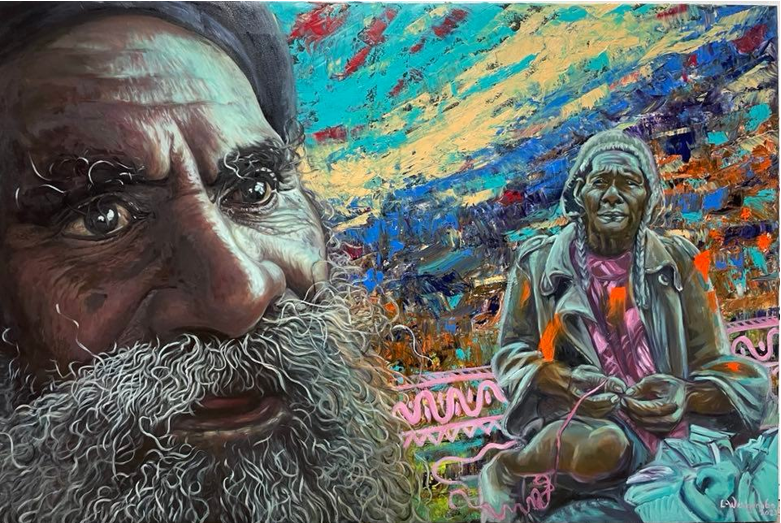
Image Source: “Ruminate” by Lesley Wengembo (Australia Gallery)
By Luke McKenzie
In the lead-up to Independence Day, I want to acknowledge some of my favorite elements that make up the nation of PNG. These are some of the things that impress me, teach me, and bring me joy. They have kept me coming back over the past seven years and will keep me around for some time yet.
- My wife: PNG has given me my greatest gift, my life partner and favorite person. Her resilience, passion, humility, mercy, and love of God are an inspiration to me and many others. She is a profound embodiment of many of the attributes that follow. She works hard to extract the best from her culture and never gives up on her country. I am so blessed by the ways she helps me understand and integrate into family and community.
- The people I have met—I am so thankful for all the Papua New Guineans who have welcomed me into their country and taught me so much. From my arrival, many Papua New Guineans have generously answered my questions and looked out for me, ensuring my growth, comfort, and safety. Many have shared their stories with me. We have laughed together as I have slowly learned pidgin, such as when I said someone “gat tripla het” (is very stubborn) instead of “gat tripla tingting” (is imaginative). My mistakes and missteps have been met with patience and kindness.
- Positivity and grace—Many Papua New Guineans are appreciative, optimistic, and resilient. In the land of the unexpected, patience and grace are often shown. People find opportunities to smile, sing, and dance amidst adversity. While individuals work to address poor service delivery, poverty, and tribal violence, there is still a prevalent spirit of thankfulness, acknowledgement of our fallibility, and a desire for unity.
- PNG’s art and writing—I love going to the Saturday Port Moresby art market to see the colorful and varied paintings and bilums. I still remember when I first saw Lesley Wengembo’s Ruminate (pictured at the top of this article). PNG has a rich body of fiction, memoir, and poetry. Among others, Sir Albert Maori Kiki, Josephine Abaijah, Daniel Kumbon, and Michael Dom provide piercing and beautiful insights into Papua New Guinean history, life, and relationships. I look forward to reading more and am excited by many emerging authors such as Michael Kabuni, Kingtau Mambon, and Aseneth Waide.
- A holistic worldview: My pastor often compares the West’s compartmentalized “handbag” or “backpack” worldview to the holistic Melanesian “bilum” worldview. In PNG, it is obvious that all parts of a person—their work, family, faith, tribe, and politics—mix, overlap, and combine. Papua New Guineans often seek to address problems holistically. This recognizes the complexity of individuals and society. We are mind, body, spirit, and soul. This is endorsed by the Constitution’s first National Goal of integral human development. When I visited Parliament House, our tour guide moved seamlessly between discussing politics, philosophy, religion, history, and architecture. There is no sacred-secular divide.
- God at the center: The Christian God and spirituality have a principal role in society, culture, and many people’s thinking. I am writing this on National Repentance Day, a public holiday. God is recognised as being in control. Because so many people have this belief, prayer is widespread. Government departmental meetings begin with prayer. While this risks being symbolic or ritualised, it is acknowledged that much is outside our control; humility and dependence are needed.
- Maintained independence and democracy: After 50 years, PNG remains a sovereign country. Papua New Guineans set the nation’s laws, norms, and rules of engagement. Leaders are elected. Development can indeed be sought through Papua New Guinean forms of social, political, and economic organization as per the Constitution’s fifth National Goal. While this may include partnership with outsiders, PNG’s successes are its own to claim. Compared to much of the world, the media is free and information is accessible (although less and less so). Papua New Guineans are free to be Papua New Guineans.
- Cultural diversity:A land of a thousand tribes; over 800 languages sustained over generations. PNG holds host to an abundance of manners of celebrating, mourning, leading, communicating, and paying respect. There are patrilineal and matrilineal societies; people who you can’t tell what they are thinking and those who will leave you with no uncertainty. I am often in awe of the way PNG organisations – made up of people with so many different ways of doing things – pull together and achieve their goals. This is powerful and beautiful. Despite this diversity, there is still a sense of national unity. Many Papua New Guineans also capably operate across drastically different contexts: village life, the melting pot of Port Moresby and the global arena.
- Natural beauty: PNG’s cultural diversity is only exceeded by its natural diversity. The country is geographically stunning and full of amazing wildlife. Many of its creatures can be found nowhere else. Its seas are teeming with creatures beyond number. There are gorgeous sunsets, beautiful birds and active volcanoes. Many Papua New Guinean communities live sustainably and have commendably fought to protect their natural environments. It is a shame some foreign companies have not done likewise.
- PNG food: Mumu, aigir, pariva, kumu, Chicken Arrow Biskit and garden kaikai. The best PNG food is outstanding; often creamy, salty and sweet. Gardens sustain the nation. One of my fondest memories is when a colleague’s family (who we had never met before) hosted me and my parents at very short notice for delicious aigir and mumu in Kokopo a couple of years ago.
How about you? I would love to hear what you will be celebrating about PNG this month.
Luke McKenzie is an Australian economist working in Port Moresby, Papua New Guinea.


 Lanesia Knots
Leave a comment