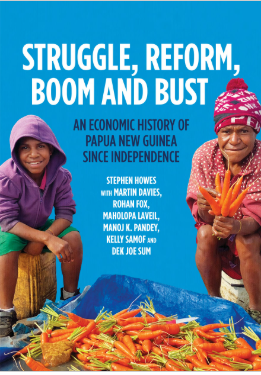
50 years on after independence, Papua New Guinea’s (PNG) economic record is both remarkable and disappointing. Struggle, Reform, Boom and Bust: An Economic History of Papua New Guinea since Independence, by Professor Stephen Howes and colleagues, provides the most comprehensive account yet of why this is the case.
They tell the story through four eras. The first covers the late 1970s and 1980s, defined by what the authors call “early struggles”. During this period, PNG avoided immediate crises and maintained fiscal discipline under a hard-kina exchange rate policy; growth was far slower than expected. Rising costs, weak service delivery, corruption, and growing law-and-order problems took root. The second era, called “the nineties”, marked a sharp break: a period of volatility, crisis, and reform. This was PNG’s most turbulent decade, starting with the Bougainville crisis and continuing with inflation, currency collapse, and repeated International Monetary Fund (IMF) interventions. Yet this was also the country’s most reformist period. Wage controls were abolished, the currency was floated, the central bank was made independent, Value Added Tax (VAT) introduced, and subnational governance experienced an overhaul.
The authors called the third era “the noughties.” This period brought an unexpected boom, starting around 2004. Commodity prices surged, the PNG LNG project was launched, and revenues soared. Political stability under Michael Somare and later Peter O’Neill reinforced optimism for the country. Yet fiscal institutions failed to save, temporary trust funds got drained, and reform momentum stalled. The most recent period, from the mid-2010s into the early 2020s, is described as the “quiet bust”. With LNG project construction completed and oil prices collapsing, growth slowed, non-resource GDP per capita declined, and businesses faced chronic foreign exchange shortages. Fiscal deficits ballooned, and nationalism and state-led rhetoric intensified under the banner of “Take back PNG”.
The book’s central argument is that commodity prices alone cannot explain these cycles: institutions matter. The authors introduce the concept of “hyper-politics”: a fragmented, highly localised, and clientelist system of aggressive political competition dominated by the business-political class. Members of parliament are elected on narrow parochial bases, parties are weak, and turnover is high. This system, with feedback loop from insecurity stemming from poor law and order and insecure property rights, has remarkably sustained a “weak but stable state”. Consequently, fiscal discipline, service delivery, and policy continuity were undermined. Bold reforms, such as those of the 1990s, are rarely sustained, and resource wealth squandered.
A major contribution of the book is the construction of PNG Economic Database, a long-run series of macroeconomic indicators dating back to 1975. This allows the authors to distinguish between resource and non-resource Gross Domestic Product (GDP), giving a clearer view of the “lived economy”. The findings are sobering. Over nearly five decades, non-resource GDP per person has grown at only 0.4 per cent per year. Formal sector employment has expanded at just 1.5 per cent annually, well below population growth of 2.6 per cent. In practical terms, this means that while overall GDP rises during resource booms, the welfare of ordinary Papua New Guineans has barely improved.
Though the policy implications are direct, they are not easy. Currency non-convertibility remains a binding constraint on growth. Fiscal management has continued to fall short. From Mineral Resources Stabilisation Fund (MRSF) of 1970s to unimplemented Sovereign Wealth Fund (SWF) of 2010s, the country has repeatedly failed itself to institutionalize saving during booms. Land administration is dysfunctional, with insecure land titles preventing agricultural expansion, urban development, and investment. And perhaps most alarmingly, human development outcomes remain among the worst in the world. PNG’s vaccination and nutrition indicators are shockingly low, and the book calls for a return to the independence-era emphasis on equality, including gender equality and child health.
Comparative perspectives used in this book make its analysis insightful, useful and fair. The authors stress that PNG is not unique. Its challenges – resource dependence, weak state capacity, volatile growth – are common across many developing economies, particularly in Africa. However, PNG’s combination of resource reliance, weak state capacity, and the hyper-politics that feed the national regime stability makes it unique. Being the world’s most ethnolinguistically diverse and rural country adds to that uniqueness. Such comparison tempers both the optimism of those who see every new resource project as transformative and the despair of those predicting collapse. Nevertheless, PNG has muddled through, avoiding collapse but failing to secure sustained development.
Still, the broader lesson from the book is sobering. Resource wealth is not a destiny. What matters are the institutions that govern the resources. PNG’s past five decades show that resource booms are temporary, while institutional weaknesses have endured the test of time. Unless these weaknesses are addressed, PNG’s next boom risks becoming just another bust. PNG’s current Treasurer, therefore, fittingly described Struggle, Reform, Boom and Bust as “ a profound wake-up call for PNG”.
The book will quickly become the standard reference on PNG’s economic history. For scholars, it sets a new benchmark in combining rigorous data with political economy analysis. For policymakers, it provides lessons that have been learned painfully but too often ignored. For the general public, it provides a clear explanation of why, despite massive resource wealth, most promises since independence remain unfulfilled.
 Lanesia Knots
Leave a comment