According to PNG’s National Statistician, the country’s growing population is “scary”. It’s scary because the economy is struggling to support them. The population is about to pass 12 million. And every year, over 200,000 babies are born. One in three of these births are unplanned.
The country’s own National Demographic and Health Survey (DHS) tracks two key measures of fertility. First is the Total Fertility Rate (TFR) and second is the Wanted Fertility Rate (WFR). In PNG, TFR is 4.2 children per woman, while WFR is 3.0 children per woman. The difference between TFR and WFR leaves us with a gap of 1.2 extra children per woman; that’s roughly 40 percent higher than desired. In other words, despite the desire to have three children, women end up with four.
So how many unplanned people is that? When asked about their most recent birth, 17 percent of women indicated that it was unwanted (no more children desired) and 11 percent indicated that it was mistimed (wanted later, not now). Taken together, 28 percent of births were unplanned. With 230,000 births annually, that means, 64,400 babies each year are born earlier than their mothers wanted or not wanted at all. Over a decade, that adds up to more than 600,000 people. That’s equivalent to nine Manus Province, added unintentionally.
Why are there so many extra births? First, family planning is limited in the country. Only 37 percent of women have access to contraceptives. In rural areas, contraceptives are scarce-less than 35 percent. Women who want to delay or stop childbearing often cannot. Second is early marriage and teenage pregnancies. For every 1000 girls, 65 begun childbearing before their 20th birthday. This is above average of developing countries and highest in the region. Third is education gaps. Women with higher education marry at age 23.5 years compared to 18.4 for those with elementary education only. Fourth and finally, is cultural norms and demands from livelihoods. Children are seen as labour and security in rural PNG, thus, households residing there sustain high fertility preferences.
Unplanned fertility is not evenly spread across the country. It varies sharply by wealth, region, and education. Poorer households want larger families but overshoot those targets (WFR:3.6 vs TFR:5) compared to wealthy households (WFR: 2.4 vs TFR: 3.4). Highland’s region has higher fertility preferences (WFR:3.0 vs TFR:3.8) compared to the Islands region (WFR:2.8 vs TFR:4.5). And women with little or no schooling prefer around three children, while those with higher education around two.
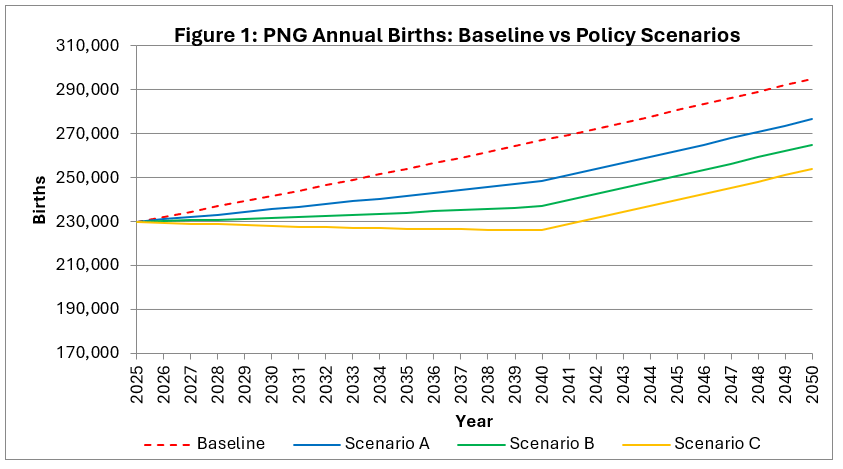
Without decisive policy intervention, annual births would reach close to 300,000 by 2050 under a conservative 1 percent growth rate (Figure 1). Family planning on its own is not enough to alter this trajectory in an impactful way. Scenario A models a reduction in unplanned births from the current 28 percent to 20 percent within 15 years, while Scenario B targets a deeper reduction to 15 percent. In both cases, the downward pressure on total births is relatively modest, still. By contrast, for Scenario C, which combines family planning with investments in education and later marriage shows a strong impact. Annual births are contained below 250,000 almost until mid-century.
For population growth to be on more sustainable path, births should truly reflect the optimal choice of households given their constraints. When families decide when to have children, these children are more likely to have proper education, enjoy better health and grow up in household with less poverty. And not the least, it keeps away additional pressures on the environment and the economy too. This could help National Statistician spare the word “scary”.
To sum it up, the PNG is struggling in taking care of its population. Yet, every year, it adds over 60,000 unplanned citizens to its population. DHS clearly shows that women want fewer children than what they are having now. Not helping them closing this gap will remain a missed opportunity.
Data Notes.
- All the data are taken from 2016-18 PNG Demographic and Health Survey Report , except those with links.
- Cover Photo is take from One PNG.


 Lanesia Knots
Leave a comment