Vanuatu just pulled off something no one expected. They bought gold! Something people might think its not a big deal. But for Vanuatu, it’s their first time. But their move is not an outlier. The world is buying gold.
Since 2008, Central banks have added more than 5,000 tons of gold to their vaults. In 2022 alone, the record was 1,082 tons, the biggest buying spree since 1950. Russia, China, Türkiye, Kazakhstan, Uzbekistan… everyone’s getting in on it. There are two main reasons for this. First, US interest rates have been negatived for a decade. Second, financial sanctions have become the new weapon of choice. So, these emerging markets are hedging. Diversifying. And protecting themselves.
Meanwhile in Melanesia? We’re still hugging the USD. Like our ex, we know, we should let him/her go but can’t. See figure 1 below. World Bank reports time series data of total reserves with and total reserves without gold in USD. The difference could give us some approximate value of gold as share of total reserves in each country. Figure 1 below shows each Melanesia reserve value in gold as share of total reserves since 1981. Gold share has been falling for all countries over time.
Figure 1: Gold as Share of Total Reserve (1981-2023)
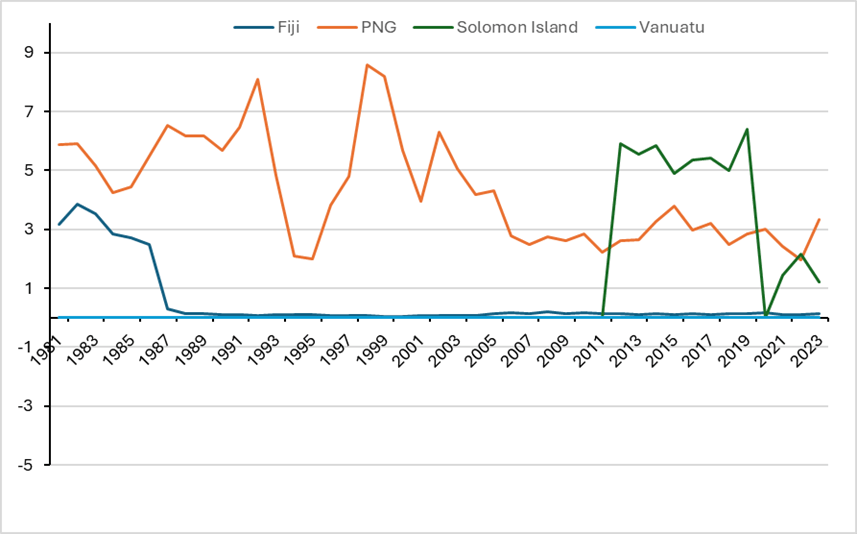
Vanuatu’s share of gold in total reserve has been zero since 1981. But in August, last year, Vanuatu broke that decadal pattern and joined the declining gang of gold reserves holders. The country bought around US$4 million in gold which is equivalent to VT 481.6 million.
Fiji now has almost no gold. That wasn’t always the case. In the 1980s, Fiji held a tiny bit of gold—around three percent of its total reserves. But then ran that position down. Today? Gold share is approximately 0.13 percent that is about USD 2.1 million. Can we count on this miniscule figure? No, to be blunt. Meaningful hedge against USD shocks seems effectively zero.
And what about PNG and Solomon Islands?
PNG’s gold share is only about three percent of its reserves in 2023. Solomon Islands holds roughly US$8.2 million in gold, about one percent of its reserves. Both are still dominantly paper. Mostly USD instruments. There is minimal diversification. Minimal hedge. Flip the coin. Maximum vulnerability.
Here’s why we should care. More than 60% of our export earnings come from volatile stuff, the logs, the fish, the copra, the LNG (aka the volatile leader) and nickel (one of LNG’s gangs). When commodity prices drop, foreign exchange earnings fall. Reserves gets squeezed. That’s the fact. At the same time, if global interest rates rise, bond portfolios lose value. That’s duration risk layered on top of export volatility. And if the USD falls at the same time? You’ve got your concentration risk right there. There’s no backstop. Gold can be that backstop. A small allocation to gold does not solve everything. But it does changes the structure of risk.
For illustration. If PNG put just two percent of its roughly US$3.9 billion in reserves into gold, it would hold around US$78 million worth of gold bullion. A modest five percent annual price rise would add about US$20–25 million in valuation over five years. Storage and insurance would still be well under US$1 million a year.
This is exactly why emerging markets are doing it. If Melanesia had held even one percent of reserves in gold in 2022, the region would’ve had on the order of US$70 million in bullion—gaining when gold prices rose about 14 percent while bond portfolios were getting squeezed.
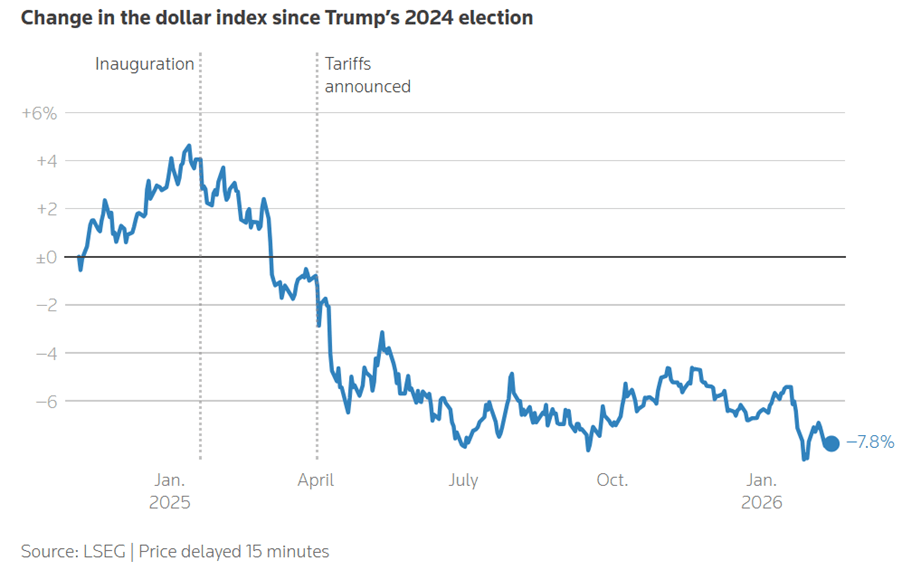
But why are Fiji, PNG, and Solomons still hanging heavily on USD? Its because of tradition. Status quo bias. The habits. Because of “this is how we’ve always done it.” Outside of that, the fact is because of what economist called “ dollar dominance”. USD is the backbone of global finance. It accounts for 56 percent of global reserves and actively involves almost 90 percent of global foreign exchange market trade. But the global financial system is not the one we “always had.” It’s fragmenting. It’s weaponized. Its dominance is cracking. Don’t believe me? See the graph below from Reuters. Dollar dominance is falling. But we’re still acting like it’s 1990s.
Reserves aren’t just for smoothing our imports transactions. They are our sovereignty tool. Our shock absorber. A 2–5 percent of gold allocation wouldn’t replace the USD. It would protect us from it. Good to see Vanuatu recognized that. They are bold enough to say, “We refuse to be fragile.”
The challenge is on. Will the so-called big brothers—PNG, Fiji and Solomon Islands, keep clinging to a mostly paper strategy? Or will they finally show leadership to diversify like every smart emerging economy on the planet?
The sour truth is that size doesn’t determine resilience. Composition does. Vanuatu took that first step. The rest of Melanesia has a choice.
Ref:
(1) The featured image is taken from Gold Invest.
 Lanesia Knots
Leave a comment