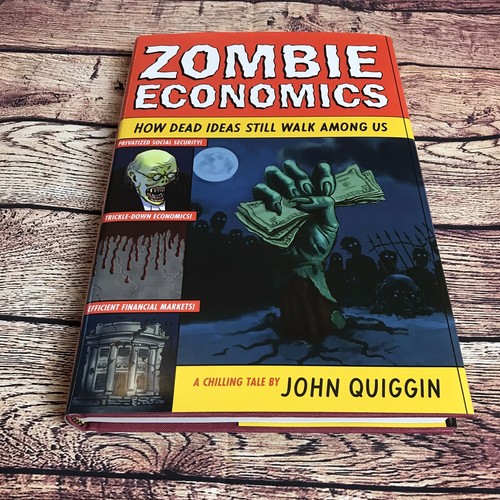
In his thought-provoking book, Zombie Economics: How Dead Ideas Still Walk Among Us, Australian economist John Quiggin argues that many bad economic ideas that helped create the Global Financial Crisis (GFC) are still influencing policies today. And like zombies, they refuse to die.
The zombie ideas in his book are the Great Moderation, the Efficient Markets Hypothesis, Dynamic Stochastic General Equilibrium models, Trickle-down Economics, Blanket Privatization, and Expansionary Austerity. Quiggin makes the case that all these ideas were exposed by the financial crisis, yet they still linger in our policymaking, textbooks, and public debate.
And what makes Zombie Economics compelling is not just its critique but also its accessibility as well. Quiggin neatly walks readers through complex economic theories with clarity and humour. He makes the book read more like public reasoning than academic combat.
In Melanesia, many of the “zombie ideas” Quiggin identifies might have been quietly influencing our policy over the decades. For instance, the trickle-down logic behind corporate tax concessions. Policymakers are told that if conditions are made favourable enough for investors, the benefits will inevitably reach rural communities. But the opposite has happened.
Look at LNG Project case in PNG. They have been given massive tax concessions, and the project has truly contributed to increased GDP. But the economy has not translated the gains into an improved standard of living for most people in the country. Things have been getting worse. Tax concessions and the idea that rising tides raise all boats don’t seem to be materialising in the country.
Quiggin’s message reminds us that if the global financial crisis couldn’t kill off some of these theories, we shouldn’t assume their survival means they’re still valid.
As an academic, Quiggin doesn’t just tear down. He also offers a vision for rebuilding: a return to more grounded, empirically informed macroeconomics; a clearer role for the state in stabilization and service delivery; and a healthy scepticism towards markets where they have failed.
And that’s relatable in Melanesia. The COVID-19 pandemic reinforced the importance of having strong public institutions. Climate change and disaster risks require policy models that go beyond price signals. Quiggin’s critique implies a more pragmatic, less ideological approach to economic development—one that blends state leadership, market tools, and community voice, which is an integral aspect of Melanesian society.
Zombie Economics is not a new book. It was first published in 2010 and updated in 2012. But its relevance has endured the test of time. Countries in Melanesia and broader Pacific are experiencing post-pandemic recovery, inflation, global debt tightening, and climate shocks, which in itself calls for the need to rethink what we assume about markets, growth, and development.
Here is the thing. Bad ideas don’t die on their own. They must be challenged, dismantled, and replaced. Zombie Economics helps us start that conversation.


 Lanesia Knots
Leave a reply to John Quiggin Cancel reply