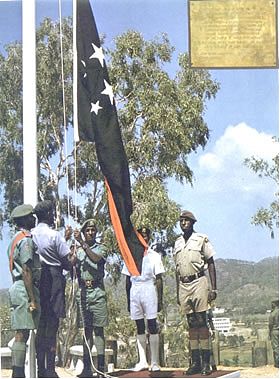
Next Tuesday, we will be celebrating our Independence Day. It’s coming, and most of us are optimistic, keen and looking forward to celebrating it. Yet, some of us, the Papua New Guineans, are pessimistic. Too often we cry, We’re poor, We lack this.We lack that. Or “Why aren’t we like Australia by now? Why aren’t we like Japan by now?”
See, how do we expect our young nation to match countries with centuries of state-building, industrial revolutions, and multiple wars that forced them to reorganize their societies? Our initial conditions are not the same.
Well-versed economists from the Australian National University and the University of Papua New Guinea clearly state in a recently published PNG’s economic history book that our country is still a young nation. A 50-year-old person could be in midlife, but a 50-year-old nation is barely entering adulthood. We inherited borders drawn without our say, plugged into global capitalism with minimal preparation, and our given institutions are borrowed rather than built. So, expecting us to be “world-class” in half a century? Come on. It’s like demanding a uni student in second year to publish a Nobel-winning paper.
Look at history. The United States took almost 200 years after independence to desegregate schools. Australia didn’t even recognize its First Nations people properly until the 1960s. Singapore—the classic “why can’t PNG be like them?” case—went through riots, poverty, and instability before hitting the right chords. Nations stumble, struggle, and experiment before they stabilize. So why do we think PNG should bypass all of that in record time?
But saying “we’re young” is not an excuse for being stuck (stunted). 50 years of being youth is enough time to stumble, struggle and experiment; now we should be moving on. Our benchmark isn’t “Are we Australia yet?” It should be “Are we better than we were 10, 20, or 30 years ago?” And the reality is, we are worse off in terms of our living standards than we were during the post-independence era. We cannot ignore the fact that most of our people are not happy with the way the country is going. We need change.
The next 25 years will decide if our country matures into a stable, innovative nation—or remains trapped in resource dependency and infantile politicking that we have been observing. Fifty years is youth. But seventy-five, one hundred? Our “we’re young” cards would expire. And we won’t get away with it. The choice is ours. Either use our resource wealth to build systems that outlive us or keep kicking the can down the road until it collapses. If the ball is in our court, then elect leaders that should build a fair court and fix the rules of the game.
Comparing ourselves to 100+-year-old countries will always make us look bad, as we struggle to keep up with their timelines while playing on patchy courts. But if we measure against ourselves—our own messy but determined journey since independence—we can see the progress and spot the gaps honestly. We don’t need to copy anyone else’s path, but we can learn from them and own ours. And PNG’s Economic History Book is a good place to start such conversations.
We will kick in fifty, comes 16th. Our economic numbers are not promising, but remember, the ink on our story is still wet. Let’s stop whining about how unfair things may seem. Our past is gone. It’s our lesson. Our priority is to elect leaders who can fix the rules of the game. This is our country-our history. If we are not satisfied with how things are going, flip the script and rewrite it for the next 50. Bring it on.
“Don’t let the pressure of others eating their harvest make you eat your seeds.” ~African Proverb.
Ref:
(1) Cover photo: PNG AA (2005)


 Lanesia Knots
Leave a reply to John Quiggin Cancel reply