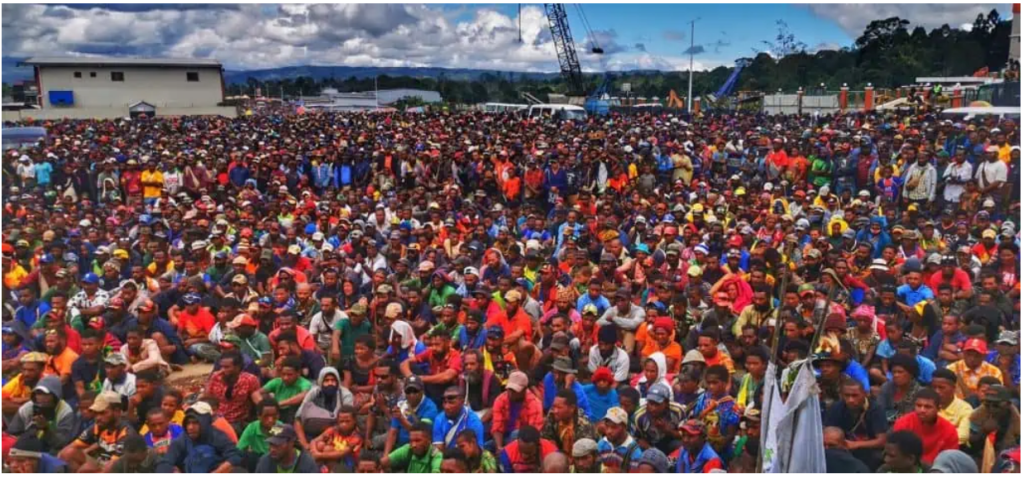
Urbanisation has scarcely taken off in PNG. In 2024, 85 percent of PNG’s the population still lives in rural areas. This is despite decades of development plans and national urban policies such as PNG’s National Urban Policy 2010–2030. As share of total population, rural population remains at the same level as it was in 1986 (Figure 1) making PNG is one of the most rural countries in the world.
In 2023, PNG’s urban population is estimated to be 1,425,770, up from 1,385,794 in 2022—a growth rate of 2.9 percent. This is a modest growth compared to its neighbours and does not imply deep structural shifts in occupations or incomes. The persistence of a large rural majority is what I refer to as “stuck population”.
Figure 1: Rural Share of Population: PNG Vs Neighbours’ (1960-2024)
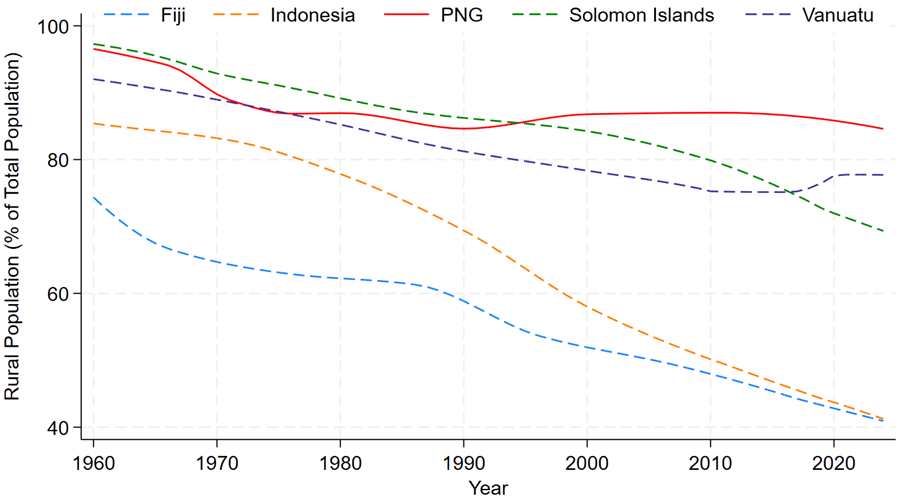
Source: World Development Indicators (2026)
Earlier this year I had an opportunity to give a talk to new graduates joining PNG’s Department of Treasury on this topic; “stuck population”. I made an argument that PNG’s stuck population carries deep fiscal and developmental dilemma for services delivery.
The dilemma is that more people are in rural area contributes less to tax given them being in less productive sector of the society, but they demand more services. And delivering these public goods and services to them is expensive. Sometimes remote communities are mostly with very low population density and difficult terrain and that in itself carries high cost per capita for roads, health clinics, schools, and even basic logistics. Given that clientelist political nature of PNG and thus incentive to spread funding across many small wards, there is resource fragmentation. Each ward gets minimal service that are not enough to scale and transform productivity.
If we look at the revenue side of the economy, outside of grants, PNG’s tax-to-GDP ratio is narrowness of the formal tax base. In 2024, PNG’s tax-to-GDP ratio is just 15 percent, which is well below Asia-Pacific regional average of 20 percent. Within that revenue structure, government has been shifting the burden of financing services over the years seeing the largest share coming from corporate income tax (CIT), followed by personal income tax (PIT) and goods and services taxes (GST) as shown in figure 2 below. Projections from the same graph shows that PNG is becoming more dependent of CIT. Put differently, the government relies on relatively few large corporate taxpayers in extractive and big-enterprise sectors.
Figure 2: PNG’s Tax Structure Overtime (1989-2023)
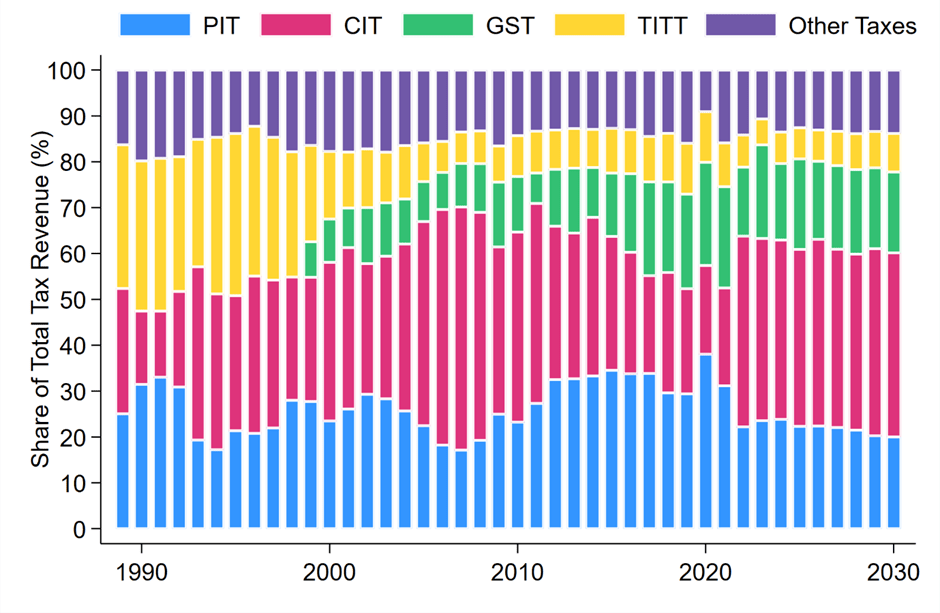
Source: PNG Budget Database (2026)
People are not paying their fair share of tax, but they continue to demand government services and this mismatch is stark. Those who pay least (in aggregate) receive demand claims that the state struggles to meet. Something has to be done. So can these citizens be moved out of rural areas?
Follow up question will be of why are many people still prefer to live in rural areas instead of moving to towns where productivity and incomes are higher? There could be thousands of explanations but clearly, barriers reinforce immobility in PNG is customary land tenure. Land ownership in PNG is social and communal, and it is not easily commodified. If one leaves the land, it means that the individual is disconnecting from social identity, clan networks, and customary safety nets. No secure tenure or trust in cities’ institutions in urban centres are also not strong pull for village people.
Further, formal employment opportunities are also very limited outside resource enclaves. The urban informal sector offers survival-level income but rarely a path out of poverty. Urban amenities — like housing, water, sanitation — are often lacking or unaffordable for new arrivals, especially in planned areas. Urban services and infrastructure have not expanded fast enough to match even modest migration in the country.
The resulting stuck equilibrium has serious economic consequences. Low Labor mobility means that workers cannot shift from low-productivity agriculture to higher-return urban jobs. It traps PNG in a dual economy of resource and formal sectors on one side, subsistence and informal rural sectors on the other. Productivity growth in agriculture is weak, and non-resource sectors also remained underdeveloped. The narrow tax base constrains public investment, making it harder to finance the infrastructure and institutions needed to catalyse urban growth or high-productivity rural linkages.
In sum, PNG’s stuck population is a structural trap. Too few opportunities to move, and too many constraints preventing towns from absorbing people productively. The data show how extreme the rural dominance is, how narrow the tax base remains, and how weak the linkages are. Getting unstuck means building bridges not the physical only but also in economic, fiscal, and social institutions that can give seamless migration between villages, towns and cities.
References
(1) Featured Image is taken from Island Business
 Lanesia Knots
Leave a comment