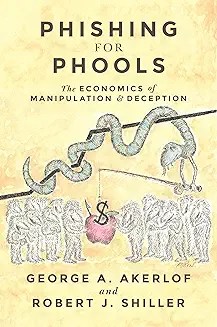
Two winners of the Nobel Memorial Prize in Economics, George A. Akerlof and Robert J. Shiller, wrote two great books. One is Phishing for Phools: The Economics of Manipulation and Deception. The other one is Animal Spirits: How Human Psychology Drives the Economy and Why It Matters for Global Capitalism.
My Aussie friend, Luke McKenzie, gave me the former last month as he was preparing to return to Australia after serving in my country’s Department of Treasury for almost four years—one of the longest serving Australia’s Department of Treasury staff in PNG’s Department of Treasury. I write these reflections of the book he gave me in remembrance of him and also in appreciation of the many good conversations we shared over the years about economics, policy, markets, PNG and development challenges we faced here in the country. I hope my friend Luke return with his wife Juliette (aka Jules) to work in PNG again in the future.
Luke is truely a diplomat who is open to ideas and to honest discussion about what works and what does not work well in economics. He also understands that, where choices are difficult, trade-offs must be recognized. That is doubly natural of someone who formally studied economics.
Economics is a powerful tool for understanding man kind and its society. Free markets, one of those economic system, despite being elegant and efficient in allocating a society’s scare resources have through price mechanism, it does have its fair share of inherent limits.
Phishing for Phools: The Economics of Manipulation and Deception sheds some light on that. This book critiques the belief that free markets always produce good outcomes. The authors do not reject markets. In fact, they recognize that markets have produced a cornucopia of goods, services, innovation, and choice. But they argue that the same market forces that give consumers abundance also spawn incentives for manipulation, deception, and rip-offs.
Phishing equilibrium is the central theme of the book .In economics, an equilibrium is a stable market outcome where buyers and sellers no longer have any incentives to move away from that state. Akerlof and Shiller extend this idea by arguing that if firms can make profit by exploiting consumers’ weaknesses, then someone will eventually do so. In that sense, manipulation then, is part of the normal functioning of competitive markets.
The authors use the word Phool to describe someone who is successfully manipulated. And that can be of two types. First, a person can become a psychological phool when emotion, temptation, or cognitive bias overrides better judgment. Or second, a person can also become an informational phool when they act on misleading or incomplete information. This helps us understands that many bad economic decisions we do as humans are not because we humans are stupid. We make those stupid decisions because markets are flooded with sophisticated lures, persuasive stories, hidden costs, and carefully designed temptations.
One of the ideas I enjoyed reading about in the book is the idea of monkey-on-the-shoulder tastes. We may truly want financial security, health, savings, and long-term wellbeing. But at the same time, we may be pulled by impulse, status, fear, desire, addiction, or social pressure. Markets knows how to speak to that weaker side of us. This is part of the explanation why unhealthy food, alcohol, gambling, credit cards, payday loans, and political advertising can become so powerful. They are designed to entice us.
Pareto optimal markets, idea commonly taught in economics was also challenged in the book. Standard economics versed us that competitive markets are efficient unless there are externalities, monopoly power, or bad income distribution. Akerlof and Shiller argue that this view is incomplete. Even where markets are competitive, they may still produce harmful outcomes if the firms profit through manipulation of our weaknesses. Of course, we can argue, that always and invariably, we are best arbiters of our decision to choose and consume. But that is not enough according to the authors. Our choices per se are shaped by deception.
Nevertheless, the authors show how reputation mining contributed to financial crises. For integrity, firms, banks, and financial intermediaries can build reputations but then draw down those reputation for short-term profit. This then can create a hidden stock of fraud or bad assets, what notable Canadian-American economist, John Kenneth Galbraith called the bezzle. When the deception is finally exposed, confidence collapses and the negative effects ripple out to the wider economy. Citizen feels the brunt of it.
The book does have its relevance to politics. Voters can be phished through emotion, identity, misinformation, campaign money, and repeated slogans. Even the intrepid voter get phished. In this way, democracy itself becomes vulnerable to story manipulation. Politicians and interest groups may craft narratives that make voters feel comfortable while quietly advancing policies that do not serve the public interest.
The book’s argument is highly relevant for Papua New Guinea. We, the consumers and households often operate with limited information, weak consumer protection, irregular income, and strong social obligations. Our exposures to these conditions create space for practices of predatory lending, fake investment schemes, alcohol abuse, misleading advertisements, and political patronage that has been observed in the country. Many of us are not poor decision-makers by nature, rather, we are operating in environments where regulatory safeguards are weak and phishing opportunities are abundant.
In sum, Phishing for Phools brings to our awareness that markets do have its other side of the coin. The very markets that can generate prosperity, innovation, and choice, can also reward unscrupulous behavior. Markets expansions should be complemented with establishments of institutions that protect citizens. Otherwise, the market will not only serve citizens—it will also phish them.
Reference.
(1) The featured image is taken from; https://www.amazon.co.uk/Phishing-Phools-Economics-Manipulation-Deception/dp/0691173028/


Leave a Reply