By Luke McKenzie
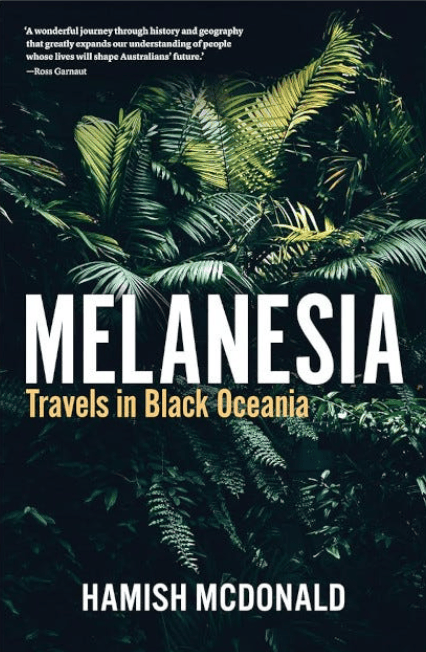
In 1920, the British administration decided to introduce a head tax in Malaita, Solomon Islands. They hoped to encourage participation in the formal labour market. Instead, the tax devastatingly led to the development of a market for indentured young men, deprivation and, in 1927, fighting causing the death of over 75 men. This is just one of the stories of terrible economic policy told in Hamish McDonald’s engaging “Melanesia: Travels in Black Oceania”, published last year. McDonald covers the region’s history, politics, economics, culture, and geography. He travels by nearly every means imaginable: airplane, bus, container ship and dinghy, and that is just from the beginning of the alphabet. Each chapter focuses on a different country or area, starting from Fiji and moving westward through to West Papua. I enjoyed each one.
While acknowledging the diversity contained within Melanesia, McDonald effectively draws together some similarities that flow across the region. These include:
- Relational, communal and reciprocal social structures that provide identity based on tradition, land and language.
- Clientelism/patronage, corruption, compensation-payback cycles and unstable politics that seem to consistently deliver the same results.
- Cargo cults
- The ongoing fight for independence (see New Caledonia/Kanaky, Bougainville and West Papua).
- The importance of pigs and psychoactive plants: kava in the south-east and betel nut in the north-west.
- The difficulty of travel.
McDonald powerfully recounts relevant social and political history. This gives a strong sense of the key institutions that shape Melanesian societies: kastom, church and politics. He also shows the value of the natural environment and the impact of different waves of foreigners and engagement with the modern world. The damage caused by outsiders seeking to extract resources is a continual theme. However, the agency and decisions of Melanesians are emphasised throughout.
The impact of the church and missionaries plays a key role in McDonald’s narrative, featuring in nearly every chapter. Some unaccountable Western missionaries did wicked things while others lived sensitively and sacrificially. Ultimately, Melanesians grasped onto their message such that Christian faith and practice have become central to Melanesian lives and societies. McDonald celebrates those Melanesian Christians who have integrated faith and kastom, provide social services and fight ecological damage, such as in the Sepik. He concludes that “more than political systems, the Christian churches provide support for Melanesia’s transition to the modern world.”
One thing that continues to interest me about Melanesian culture is the degree to which tolerance is (or isn’t) shown. In many spheres, Melanesians can be highly permissive, gracious and relationship-focused: compensation will be paid for a brother who beat up their wife, patience extended to culturally insensitive visitors and events will start hours later than advertised. But on the other hand, minor offences can sometimes receive a heavy hand (e.g. manifest in sorcery-accusation-related violence, strict parenting and tribal fighting). McDonald touches on a few of these contemporary issues (such as the re-election of corrupt politicians). However, the book prioritises attention to historical impositions and conflicts: colonists, missionaries, extractive resource projects and invaders. These groups met varied welcomes and these interactions provided mixed benefits for Melanesians. Elevating these historical conflicts gave me food for thought on how this complex history shapes the modern approach to tolerance, accountability, conflict and grace.
The author is recounting a fast-moving journey across the region (as would be required to hit so many locations on a budget). Therefore, it can be hard to get a sense of Melanesians’ everyday lives and motivations. McDonald joins a betel nut trader’s trip from Vunapalading to Kimbe to sell her product. We get to hear about her hard work but little sense of her worldview and what she does when at home. From my experience, one of the hallmarks of the region is its slow pace, communal nature and appreciation of the little things. This is shown in the Western Province chapter where McDonald gets on a trading ship that previously got stuck for two months. The ship travels slowly and ultimately doesn’t take the path McDonald wants, so he leaves his compatriots to get on a different boat to get to his desired destination.
McDonald’s book is largely targeted to an outside audience. It concludes with a wise encouragement for Australians to humbly engage more deeply with our Melanesian neighbours. Nonetheless, the book will be of interest to any reader of this blog. It provides an excellent introduction to the region and its history. Its bibliography provided me with plenty of further reading. I suspect “Melanesia” will leave readers wanting to visit one or two of the locations to experience them for themselves. Hopefully, it might even lead more Melanesians to tell their stories of the region.
About the author: Luke McKenzie is an Australian economist who has worked in Port Moresby, Papua New Guinea, for almost four years and has travelled to most of the country’s provinces.
References:
(1) The featured image was taken from: https://www.asiasentinel.com/p/book-review-melanesia-travels-in-black-oceania
 Lanesia Knots
Leave a comment