The first blog in this series described PNG’s burgeoning cash economy and its uneven rewards. This second blog examines how World Bank Mission Report proposed to expand production and indigenous participation. It draws from Chapter 2 of The Economic Development of the Territory of Papua and New Guinea.
At that time, the World Bank Mission sought to stimulate economic growth and raise living standards while preparing the Territory for self-government and eventual economic viability. Its program covered 1964/65 to 1968/69, with agricultural and livestock plans extending over ten years. The expectation from the mission was for Australia to increase its assistance. The Territory’s small pool of educated population makes skilled labor needed to run the economy a principal constraint.
To have major impact on the economic development of the Territory, the mission believes that three major principles must be adopted. First, concentrate effort where prospective returns were highest. Agricultural services and transport investment should support promising production areas. Spreading scarce staff and funds too thinly across the Territory would weaken their impact. This makes economic sense but at the cost of delaying initial development reaching most rural communities.
Second, adopt standards suited to local conditions. Buildings, public services and salary structures should be commensurate with what the Territory could eventually sustain such as simpler designs, local materials and trained indigenous staff. This could also curb costs. Expensive facilities could absorb funds needed to extend services to more people.
Third, devolve greater responsibility to local communities. Local councils should take larger roles in schools, health services and feeder roads while urban authorities should administer and help finance services. Utility charges and public housing rents should move towards economic levels. The mission also proposed community contributions and medical charges which would place part of the financial burden directly on households.
Some conditions for successful implementation of the program required changes in land access, staffing, finance and administration. The mission supported locally negotiated customary arrangements. It also advocates compulsory acquisition of the land through legal proceedings where land is required for government purposes. European investors and professionals would continue supplying capital and expertise as indigenous participation expanded. Recruitment from Australia and training Papua New Guineans were indispensable in building the workforce.
Credit also needed an institution suited to local conditions. The proposed Territory Development Finance Company would supply longer-term development loans that existing banks could not adequately provide. Stronger central planning would connect annual budgets with five-year programs. The departments needed reorganisation, and district officers needed greater leeway to act without repeatedly referring decisions to Port Moresby. Coordination and local initiative would drive implementation.
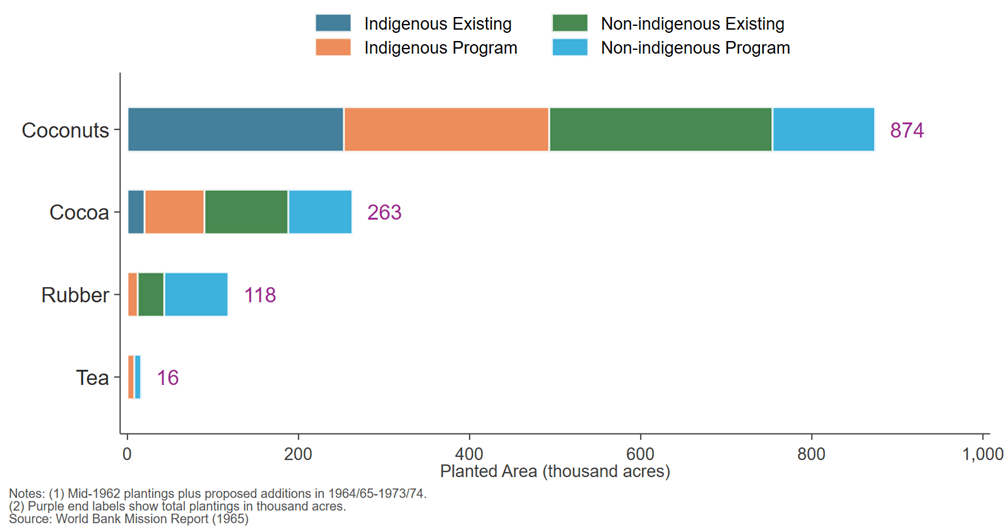
Sector recommendations translated these principles into programs. In agriculture, the mission proposed expanding commercial holdings through extension services, research and training. The planting program gave primacy to coconuts and cocoa, while also promoting rubber and tea (Figure 1). It envisages increasing cattle numbers to 300,000 over ten years. Logging and timber processing would expand, while fisheries required further research and continued support for subsistence production.
Figure 1: Ten-Year Crop Planting Program
For manufacturing, the mission recommended investment incentives, credit and better information about commercial opportunities, alongside support for cooperatives and handicrafts. To develop tourism, the Territory needed better accommodation and international air connections. The information available during that time suggested limited mining prospects, although the mission recommended continuing geological investigation and oil exploration. Electricity investment would expand capacity at Rouna and develop the Upper Ramu scheme.
Transport recommendations followed the production strategy. Complete the all-weather road between Lae and Goroka, improve major ports and modernise coastal shipping. Feeder roads would connect productive areas to wider markets. A transport department would coordinate policy across modes, while communications charges should make services generally self-supporting. Infrastructure had to make the proposed expansion commercially viable.
In education, the mission prioritizes secondary and technical training while recommending completion of higher grades in existing primary schools. It envisaged enrolling more than 20,000 additional secondary and technical students by 1968/69. In health, it favored prevention, rural centers and training local personnel, with minor improvements to curative facilities. Housing plans combined staff accommodation, local materials and urban self-help construction. Water and sewerage providers would raise charges towards economic levels.
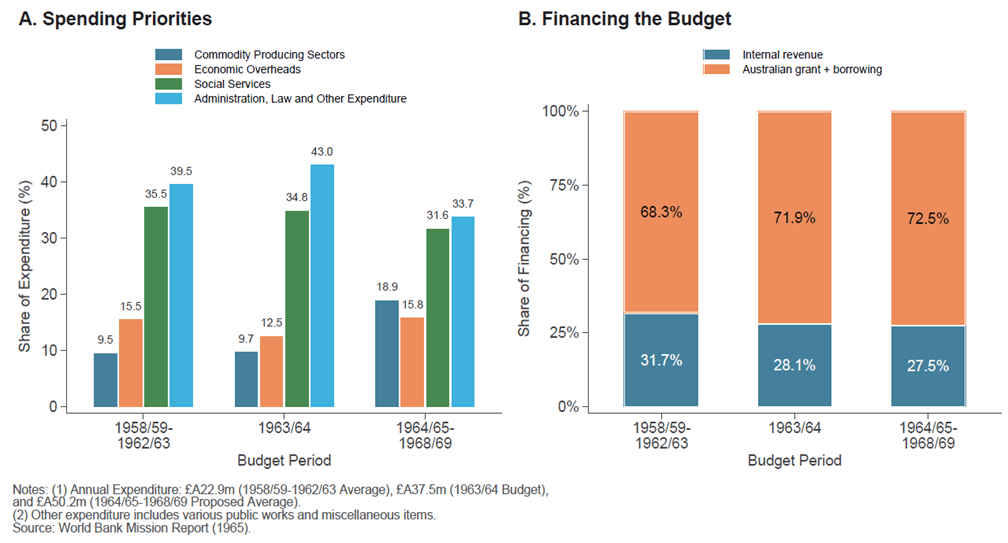
The proposed budget revealed these priorities (Figure 2). The budget projection allocates commodity-producing sectors 18.9 percent of expenditure compared to 9.5 percent in 1958/59–1962/63. It proposed raising education’s share from 11.2 to 15 percent and reducing health share from 15.2 to 10.8 percent. Because total expenditure would expand, a smaller share did not necessarily mean an absolute spending cut.
Figure 2: Budget Priorities and Financing
In conclusion, the mission sought to strengthen the productive economy and institutions that would support self-government. Its program entailed difficult choices about which region received investment first, what standards the Territory could afford and how much households should contribute towards services. The mission expected substantial Australia support for decades. But political independence arrives long before the economic and institutional transformations envisaged perfectly hit home.
References
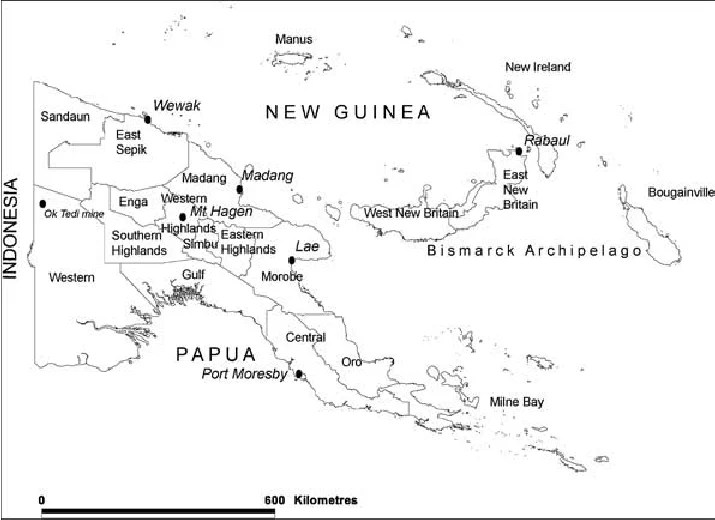
(1) The featured is taken from; https://www.researchgate.net/figure/Papua-New-Guinea-provinces-and-locations_fig1_227540749


Leave a Reply